 Tiếng Việt
  ภาษาไทย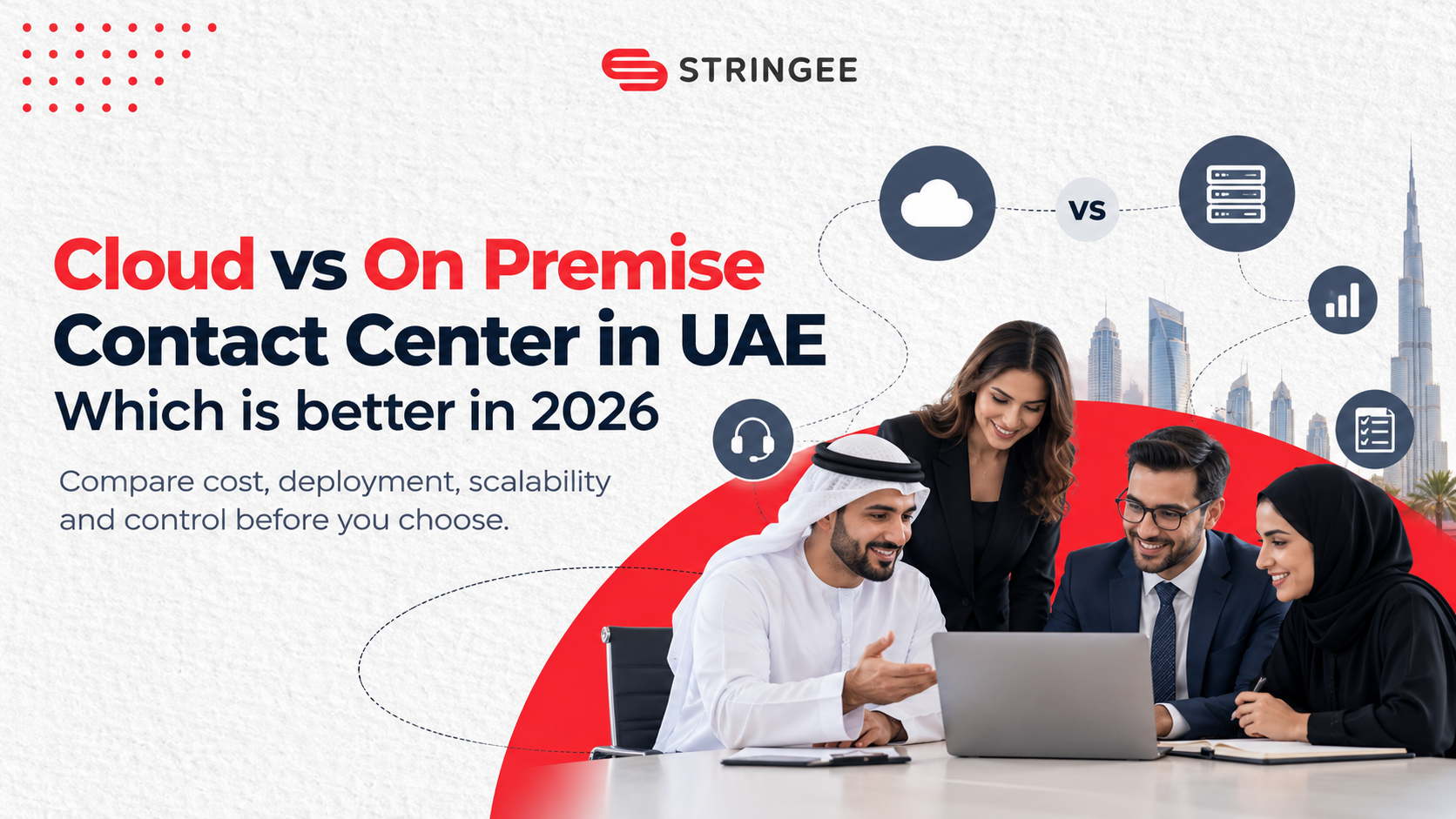

For UAE businesses evaluating a new contact center platform, one of the most important decisions is not which vendor to choose. It is how the contact center should be deployed.
Should the business move to a cloud contact center?
Keep its contact center infrastructure on-premise?
Or use a hybrid model that combines both?
The right answer depends on the company’s operating model, agent locations, existing infrastructure, IT resources, security requirements and expected growth.
For many growing businesses, cloud contact centers can reduce infrastructure requirements and make it easier to add users or support distributed teams.
But on-premise systems can still make sense for organizations that require deeper control over infrastructure or have significant legacy environments.
Some UAE contact center providers continue to offer both cloud and fully on-premise deployment specifically because both models remain relevant in the market. Voxvantage, for example, currently markets a UAE-hosted cloud CCaaS model alongside an on-premise option for large enterprises and government organizations requiring greater infrastructure control.
So which model is right for your business? This guide compares the main differences.
What is a cloud contact center?
A cloud contact center is a contact center platform hosted and operated through cloud infrastructure rather than being installed entirely on the company’s own servers.
Agents and supervisors typically access the system through internet-connected applications. The business usually pays through a subscription model based on factors such as:
- users
- agents
- usage
- communication channels
- additional services
Modern cloud contact center platforms are often referred to as Contact Center as a Service, or CCaaS. For example, Genesys currently prices its cloud contact center platform on subscription-based user licenses, with several deployment and license models available. Its Cloud CX plans start at USD 75 per user/month for CX1 on annual commitment, with higher tiers adding omnichannel, workforce management and more advanced capabilities. Genesys The main advantage of cloud is that businesses do not need to operate the entire contact center technology stack themselves.
What is an on-premise contact center?
An on-premise contact center runs within infrastructure controlled by the organization.
This may include:
- servers
- networking
- telephony infrastructure
- storage
- application software
- backup systems
The organization usually takes greater responsibility for:
- maintenance
- upgrades
- security patches
- capacity planning
- disaster recovery
The trade-off is more direct control over the underlying infrastructure. This can matter for businesses with strict internal technology policies, specialized integrations or significant existing infrastructure. On-premise contact centers are therefore not obsolete. They simply solve a different set of priorities.
Cloud vs on-premise contact center: quick comparison
| Factor | Cloud Contact Center | On-Premise Contact Center |
|---|---|---|
| Upfront infrastructure | Usually lower | Usually higher |
| Deployment speed | Generally faster | Usually longer |
| Infrastructure ownership | Provider-managed | Business-managed |
| Scalability | Usually easier | May require capacity upgrades |
| Remote agents | Easier to support | Often requires more configuration |
| Internal IT workload | Lower | Higher |
| Infrastructure control | Lower | Higher |
| Maintenance | Mostly provider responsibility | Business responsibility |
| Pricing model | Subscription / usage | Licenses + infrastructure + maintenance |
| Best fit | Growing or distributed teams | Organizations requiring deeper infrastructure control |
This table is a useful starting point, but it does not mean one model is universally better.
The correct choice depends on what the business is optimizing for.
Cloud vs on-premise: which is better for UAE businesses?
There is no universal winner.
For many growing UAE businesses, cloud will be the more practical option because it usually reduces infrastructure ownership and makes scaling distributed teams easier.
On-premise can still be the better choice where:
- infrastructure control is critical
- existing systems are deeply embedded
- internal IT resources are strong
- migration constraints are significant
Hybrid can be useful during transition.
The decision should therefore be based on:
operational fit not technology preference.
How compliance affects the decision
Deployment architecture does not remove compliance responsibilities. A UAE business operating outbound telemarketing still needs to understand issues such as:
- approved calling processes
- DNCR requirements
- calling hours
- call recording
- customer contact preferences
- repeat call controls
A cloud platform may help manage some of these workflows. But the company remains responsible for designing the correct process. For more detail, see: UAE Telemarketing Regulations 2026: Compliance Checklist for Contact Centers
Where StringeeX fits
StringeeX can be considered by UAE businesses evaluating a cloud contact center and looking to determine whether the proposed configuration fits their actual operating model.
The evaluation should begin with the workflow. Before requesting a demonstration, define:
How many agents will use the system?
Where are those agents located?
Which communication channels do they handle?
Do they handle inbound, outbound or both?
Which systems need to integrate with the contact center?
What visibility do supervisors require?
What telephony configuration is needed?
The objective should not be to buy the longest feature list. It should be to determine whether the platform supports the workflow the business actually needs.
Share the blog