 Tiếng Việt
  ภาษาไทย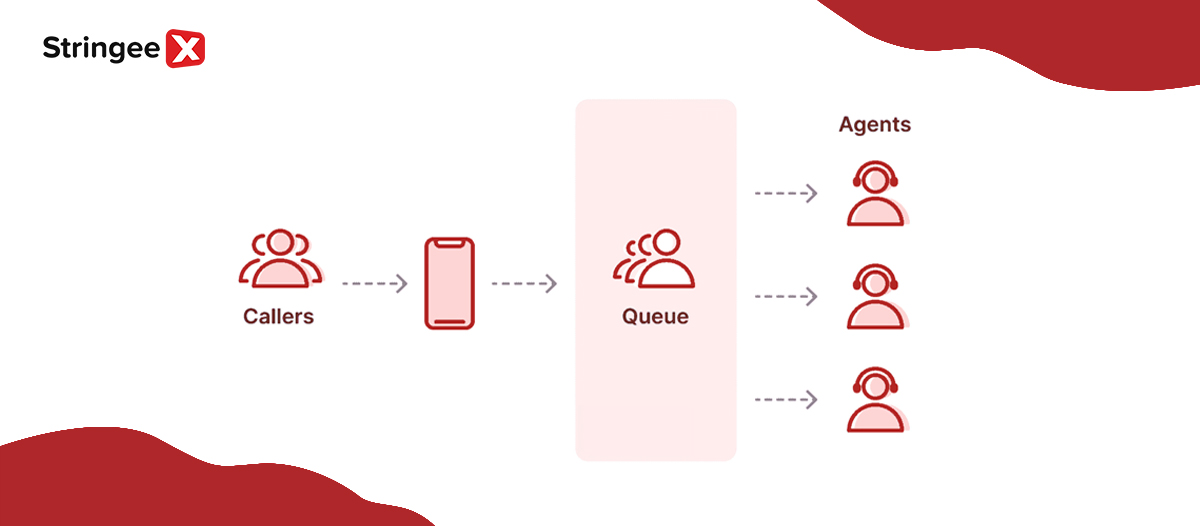

Besides IVR or ACD, contact centers usually include a call queue - the feature to route incoming calls.
Poorly-optimized call queues result in long hold times, decreased agent productivity, and a poor customer experience. The good news is that enhancing your company's call queue management strategy can provide you with a significant advantage over your top rivals.
Explore more call queues to know the definition, operation, and how it benefits your businesses.
What are Call Queues?
A call queue is one feature included in a business phone system. This feature can route incoming calls onto a virtual line (queue) by pre-established criteria, then put the callers on hold until the suitable agent to help them is available.
How does a Call Queue Work?
The call queue feature sends incoming calls to the first sales or support agent that is available. In technical terms, this strategy is known as "First In, First Out (FIFO)".
When your clients call, the phone system will play a recorded greeting to them immediately (usually followed by some enjoyable music while they wait). The queue callback feature will be activated and the next available sales/ support representative will call the customer back if they have to wait too long.
As a result, customers won't have to wait on hold, they can handle other tasks and just pick up the phone when the agent calls them back.
4 Types of Call Queues
Round Robin
A round robin call queue can evenly distribute the volume of your team's business calls. The longest idle extension will receive the incoming call so that the phone system can distribute the calls evenly to all agents.
This call queue type is an ideal option for contact centers with high call volumes or agents of equal capability and expertise.
This method can help ensure that no one employee is diverted from their primary responsibilities for too long if your company operates from a small office without a dedicated receptionist or call manager.
Ring All
Callers are sent to all available agents at once. This is the best method if quickly answering incoming calls is your top priority. If the phone of everyone rings, the first agent available will take the call.
Linear Hunt
The linear hunt calls queue direct available agents in a precise order to callers. The phone will ring in sequence, one after the other. You might use this option to make sure your customers receive the best possible answer if each of your representatives has solid expertise.
For instance, the Installation Call Queue is configured to ring the phones of User Group 1 first because that group's primary duty is to respond to inquiries regarding product installation. User Group 2 performs the installations and will be able to respond to inquiries if they are available, so if they don't answer the system rings their phones.
The phones of User Group 3 ring if they are imprisoned. Despite concentrating on financial things, they can respond to the majority of inquiries and provide your clients with a voice on the other end of the phone.
Linear Cascade
A linear cascade route calls to groups of available agents in a predetermined order. Then the system with a linear cascade call queue will add each group to the next ring group so that agents can all ring at the same time. This type is a great idea for businesses including various departments.
For instance, the system at a company starts ringing all the phones in the sales department first when the sales line receives a call. The system will begin ringing the sales and service departments simultaneously if no one answers after a set amount of time, as opposed to sending the caller to voicemail.
Every time a timeout occurs, a linear cascade increases the number of ringing phones, increasing it until the call is answered.
The Importance of Call Queues
A contemporary business phone service with a call queue feature can assist your business handle your call flow as effectively as possible. Using a call queue has several benefits for businesses, including the following:
- Enhance first call resolution rates
- Lower call abandonment rates
- Increase satisfaction and agent productivity
- Decrease customer wait times
Enhance First Call Resolution Rates
The sooner you can connect a customer with an experienced, capable, and available agent, the higher your FCR can be.
A greater FCR rate reduces operational expenses while raising overall CSAT rates. A 1% rise in FCR is associated with a 1% rise in CSAT and a 1% fall in operational expenses.
Lower Call Abandonment Rate
Call abandonment rates (CAR) measure the rate at which callers hang up while waiting to talk with an agent or during a phone call with an agent before their issue is resolved. Long hold times, unhelpful agents, and lengthy IVR menus are the main causes of a high CAR.
Think again if you believe that customers would just call you back after hanging up. Approximately 30% of callers who hang up won't bother calling your business again.
The less likely a consumer is to hang up the phone, the faster they can connect with an agent who can swiftly solve their specific problem, not just any agent. Increased sales opportunities, quicker response times, and higher customer satisfaction are the results of this.
Increase Satisfaction and Agent Productivity
Effective call queue management reduces employee turnover just as it does customer churn. Agents won't always have to deal with irate customers who are upset that the agent they connected with is unable to help them thanks to an efficient call queue system.
Additionally, agents will have more time to focus on their favorite tasks, such as giving more thorough customer care and delivering polished sales pitches. Higher production levels, employee satisfaction, and staff retention rates are the result of it.
Decrease Customer Wait Times
On average, 2/3 of customers will only wait on hold for a maximum of 2 minutes. So, it is crucial to take advantage of the chance to reduce wait times that efficient queue management affords because.
By reducing average call handling time (AHT), queue optimization allows your agents to spend more time selling and serving customers, boosting your revenue and customer satisfaction levels.
57% of people find long hold times frustrating when calling a business. With this in mind, businesses should integrate call queues in the contact center to convey to their clients how much they appreciate them.
Wrapping Up
Call queues play an integral role in the contact center that provides the option to direct incoming calls within the set of rules.
Learn more about StringeeX and experience the contact center to receive full features including call queues. Send us a ticket for more information or ring our hotline at +17079886789.
Share the blog