 Tiếng Việt
  ภาษาไทย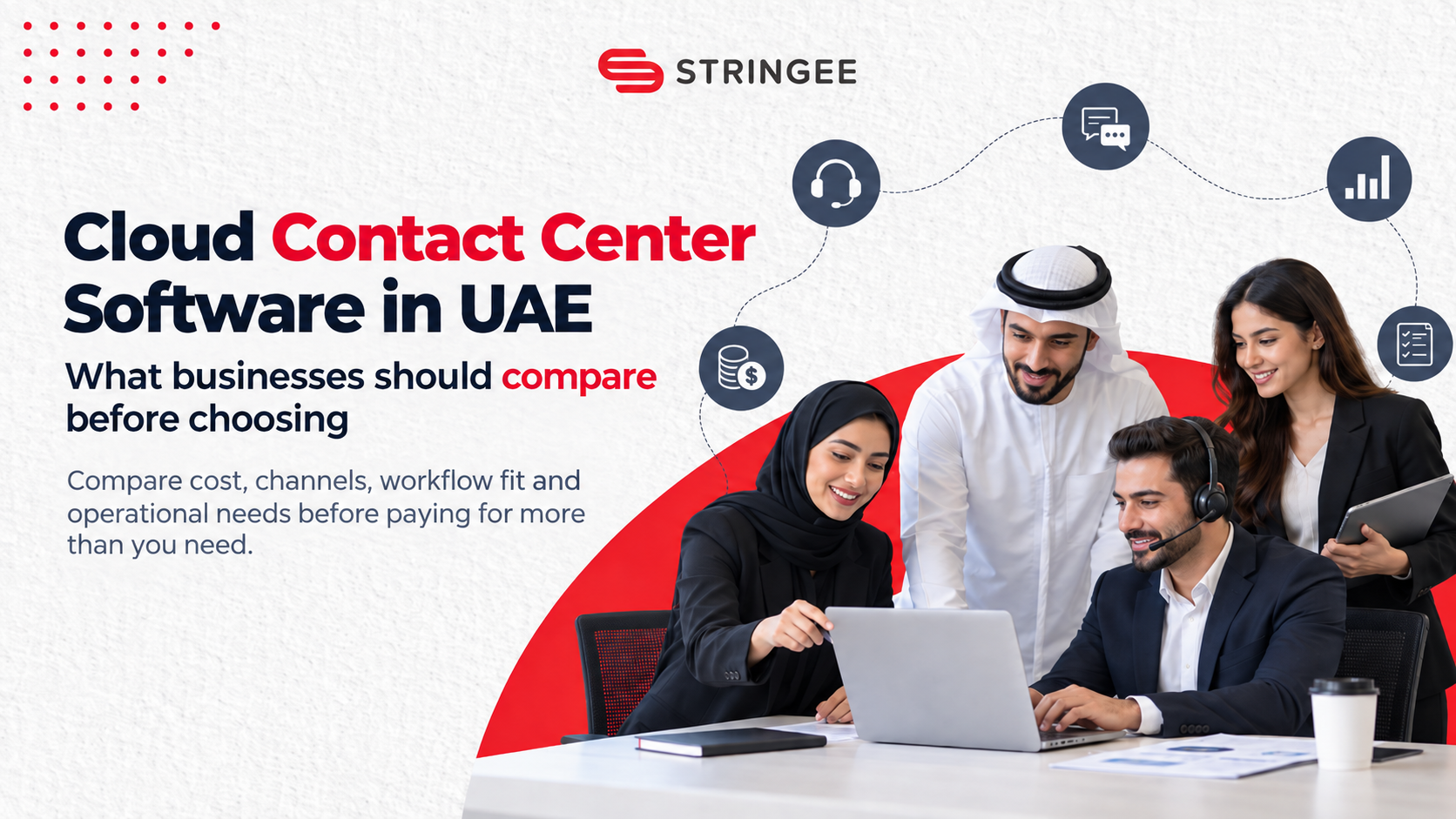

Choosing contact center software in the UAE is no longer simply a question of finding a system that can make and receive calls.
Businesses increasingly need to manage customer conversations across multiple channels, give supervisors visibility into agent performance, maintain conversation records, and operate within UAE requirements for customer communications.
At the same time, AI adoption across the Middle East is moving from experimentation toward enterprise deployment. Deloitte reports that 66% of Middle East organizations surveyed have already achieved efficiency improvements from AI, although only 34% are using AI to fundamentally redesign products, processes or business models.
That changes the buying question.
Instead of asking:
“Which call center has the most features?”
UAE businesses should ask:
“Which contact center platform fits our communication channels, team size, operating model and compliance requirements at a total cost we can justify?”
Here is how to evaluate the options.
What is cloud contact center software?
Cloud contact center software is a platform that allows customer-facing teams to manage communications without operating a traditional on-premise PBX or contact center infrastructure.
Depending on the platform and plan selected, these systems can support capabilities such as voice communications, call routing, recordings, agent management and digital customer-service channels.
An omnichannel contact center goes further by helping teams handle multiple customer communication channels within a more unified operating environment.
For a UAE business, the distinction matters.
A company with five sales representatives making calls has very different requirements from a 50-agent customer-service operation handling voice and digital conversations.
The right platform is therefore not necessarily the one with the longest feature list. It is the one that matches the actual operating model.
7 things UAE businesses should compare
1. Voice capabilities
Start with the core workflow.
Can agents make and receive the calls required by your operation? How are inbound calls routed? What supervisor capabilities are available? How are recordings handled?
Do not evaluate the software license separately from the telephony configuration.
Ask the vendor to show the complete cost of the scenario you intend to deploy, including any applicable numbers, calling charges, add-ons and implementation services.
2. Omnichannel customer communication
Customer conversations do not necessarily begin and end on the phone. Businesses should therefore determine which channels their customers actually use and whether those channels need to be handled by the same team.
This is particularly relevant in a mobile-first market. Deloitte's 2025 consumer study covering the UAE and Saudi Arabia found smartphone use to be extremely high and also highlighted the growing importance of digitally mediated commerce and AI-powered experiences.
Do not buy “omnichannel” as a label. Ask the vendor to demonstrate one complete customer journey across the channels you actually need.
3. UAE telemarketing compliance
This deserves its own section because it can directly affect operations. UAE Cabinet Resolution No. 56 of 2024 regulates telemarketing activities. Among the requirements highlighted by UAE authorities are permitted calling hours of 9:00 AM to 6:00 PM, requirements concerning identification and purpose of calls, and compliance with the Do Not Call Registry. TDRA also maintains resources for consumers concerning telemarketing and the DNCR.
Therefore, when evaluating a contact center, UAE businesses should not merely ask: “Does the system have an outbound dialer?”
They should ask:
“Can our operating process using this platform be configured to support the applicable UAE requirements?”
Software does not make a company compliant by itself. Processes, data, permissions and staff practices matter too.
4. Reporting and supervisor visibility
A contact center generates operational data continuously. Managers should determine whether they can answer basic questions such as:
- How many conversations are agents handling?
- How are calls distributed?
- What happened to missed or unanswered interactions?
- Can supervisors review the relevant interaction history?
- What performance information is available to managers?
This becomes increasingly important as the number of agents grows.
5. AI and automation but only where they solve a measurable problem
AI should not be the first criterion on the checklist. Start with the business problem.
For example, if a customer-service team receives a high volume of repetitive inquiries, automation may help reduce manual workload. If supervisors spend significant time reviewing interactions, AI-assisted analysis may potentially improve that workflow.
The Middle East is already seeing meaningful enterprise AI adoption, but organizational redesign is lagging behind adoption itself.
So before paying for an AI add-on, ask: What task will this automate, how much agent or supervisor time could it save, and how will we measure the result?
6. Pricing model and total cost
Contact center pricing can be difficult to compare because vendors do not necessarily charge the same way.
A quote can include combinations of:
software licenses + telephony + numbers + usage + digital channels + AI features + implementation + support.
This means comparing two headline “per agent” prices can be misleading.
StringeeX's internal UAE research illustrates the problem well: competitors in the market use materially different pricing structures, and some do not publish directly comparable UAE pricing at all.
For that reason, request a quote based on a fixed scenario for example:
20 agents
Required inbound/outbound calling
Required digital channels
Expected usage
Required recordings
Required integrations
Required support
Then compare the total monthly or annual cost for the same operating scenario.
7. Deployment and support
Finally, ask what happens after signing the contract.
Clarify who handles initial configuration, what onboarding includes, how agents and supervisors are trained, support hours, escalation procedures and which integrations require additional work.
A lower license price does not necessarily mean a lower total deployment cost.
Share the blog